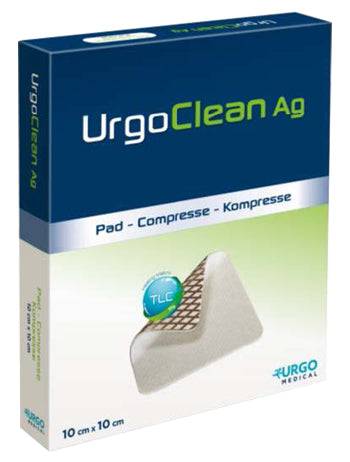
UrgoClean At
Description
UrgoClean Ag is an innovative, absorbent, gelling non-woven dressing composed of poly-absorbent polyacrylate fibers that ensure complete cleansing and debridement (of slough, fibrin, exudate, bacterial residues, and biofilm) and a TLC-Ag colloidal lipid matrix that has an antimicrobial effect. The combined action of the TLC-Ag matrix and the poly-absorbent fibers provides antimicrobial, anti-biofilm, and complete cleansing action.
- The TLC-Ag matrix of UrgoClean Ag gels on contact with wound exudate, reducing the bacterial load of the wound with a rapid and broad-spectrum action (tested on 36 bacterial strains and 4 yeasts, including antibiotic-resistant bacterial strains - MRSA, ERV, ESBL).
- Upon contact with the wound, the poly-absorbent fibers of UrgoClean Ag gel and break down the biofilm matrix, allowing the silver ions to perform their bactericidal action within the biofilm. The combined action of the poly-absorbent fibers and the TLC-Ag matrix has been shown to effectively reduce the concentration of sessile MRSA and P. aeruginosa bacteria within 24 hours and for 7 days (biofilm reduction >99.99%). The anti-biofilm action of UrgoClean Ag is superior to that of Idrofibra Ag+Extra and to a dressing with DACC.
- UrgoClean Ag removes all factors that promote bacterial growth and can limit the effectiveness of silver. The poly-absorbent fibers of UrgoClean Ag absorb and trap slough, exudate, and biofilm residue through an electrostatic mechanism. UrgoClean Ag has been clinically proven to reduce slough by 62.5% and cleanse 59% of wounds after 4 weeks of treatment (cleaned wound = covered wound with less than 30% slough).
- The dressing is removed in one piece thanks to the acrylic core present in the poly-absorbent fibres.
- UrgoClean Ag ensures atraumatic and pain-free care thanks to the moist environment provided by the TLC-Ag3 matrix.
- UrgoClean manages minor bleeding due to its hemostatic properties.
- UrgoClean Ag is cut to size and can be used with a secondary dressing.
- UrgoClean Ag can be combined with compression therapy, when prescribed.
Composition
An antimicrobial dressing composed entirely of poly-absorbent polyacrylate fibers, cleansing and gelling agents, and a micro-adherent TLC-Ag lipid-colloidal matrix (TLC-Ag: Lipido-Colloidal Technology, composed of carboxymethylcellulose particles, lipids, and silver salts) to combat local infection through a combined antimicrobial/anti-biofilm action and thorough cleansing. UrgoClean Ag has the ability to cleanse and maintain the wound clean.
How to use
Cleanse the wound using conventional wound care protocols, then rinse with saline. If an antiseptic has been used previously, rinse the wound thoroughly with saline before applying UrgoClean Ag. Use of UrgoClean Ag does not obviate the need for mechanical debridement, if necessary. Remove the protective tabs and apply the micro-adherent part of UrgoClean Ag to the wound and surrounding skin. If necessary, UrgoClean Ag can be cut with sterile scissors to fit the size of the dressing. It is recommended to use a bandage to secure the dressing and ensure it stays in place. Additionally, UrgoClean Ag can be covered with a secondary dressing appropriate for the location of the wound and the degree of exudation. If prescribed, apply compression therapy. The UrgoClean Ag dressing should be changed every 1-2 days at the start of treatment, and then as needed (up to 7 days) depending on the amount of exudate and the clinical condition of the wound. Treatment with Urgoclean Ag should not last more than one month.
The micro-adherent TLC-Ag matrix in UrgoClean Ag can adhere to latex surgical gloves. Therefore, it is recommended to moisten gloves with normal saline solution to facilitate handling of the dressing. During the debridement process, the wound may appear larger than usual. This is due to the effective removal of slough.
Warnings
Contraindicated in cases of known sensitivity to silver.
UrgoClean Ag is not recommended for use as a surgical sponge for highly exuding wounds.
Do not use UrgoClean Ag in combination with hydrogen peroxide, organomercury antiseptics, or antiseptics containing hexamidine.
Do not use on patients undergoing Open Magnetic Resonance Imaging (MRI).
Treatment with UrgoClean Ag must be performed under medical supervision.
The use of UrgoClean Ag does not replace the need for systemic antibacterial treatment for the infection, in line with local protocol.
Concomitant use with other local treatments is not recommended.
Avoid contact with electrodes or conductive gels used in EEG or ECG.
Healthcare professionals should be aware of the limited information and specific data on the prolonged and repeated use of silver dressings, especially in children and infants.
In the absence of specific clinical data, use in pregnant or breastfeeding women is not recommended.
Sterile individual packages, single-use only: reusing a single-use package may pose a risk of infection.
Do not resterilize the dressing.
Before use, ensure the sterile protective film is intact. Do not use if the packaging is damaged.
Conservation
Store at room temperature away from sources of light and heat.
Shelf life in intact packaging: 36 months.
Format
Available in:
-pack of 5 pieces, size: 6 cm x 6 cm;
-pack of 5 pieces, size: 10 cm x 10 cm;
-pack of 5 pieces, size: 15 cm x 15 cm;
-pack of 10 pieces, size: 6 cm x 6 cm;
-pack of 10 pieces, size: 10 cm x 10 cm;
-Pack of 10, size: 15cm x 15cm.
Cod. 552093, 552273, 552095, 552094, 552274, 551749
Bibliography
Lazareth I., et al., The Role of a Silver Releasing Lipido-colloid Contact Layer in Venous Leg Ulcers Presenting Inflammatory Signs Suggesting Heavy Bacterial Colonization: Results of a Randomized Controlled Study. WOUNDS 2008;20 (6):158–166.
Meaume S., et al., Evaluation of two fibrous wound dressings for the management of leg ulcers: Results of a European randomized controlled trial (EARTH RCT). J Wound Care, Vol 23, No 3, March 2014, 105-116.
Dalac S., et al., Clinical evaluation of a dressing with poly absorbent fibres and a silver matrix for managing chronic wounds at risk of infection: a non-comparative trial. J Wound Care, Vol 25, No 9, September 2016.
J. Dissemond, Results of a national multicentre observational trial on desloughing properties on wounds at risk or with signs of a local infection with a polyabsorbent dressing with silver. Oral communication. EWMA 2017.
Desroche N. et al., Characterization of the antimicrobial spectrum and anti-biofilm activity of a new silver-containing dressing with poly-absorbent fibres and antimicrobial silver matrix. Poster EWMA May 2016.
Desroche N., et al., Antibacterial properties and reduction of MRSA biofilm with a dressing combining poly-absorbent fibres and a silver matrix. J Wound Care, Vol 25, No 10, October 2016.
Percival SL. Restoring balance: biofilms and wound dressings. J Wound Care. 2018 Feb;27(2): 102-13.
Desroche N. et al, Evaluation of in vitro anti-biofilm activities of two dressings with poly-absorbent dressing fibres and a DACC-coated dressing. Poster EWMA 2017.
UrgoClean Ag data on file.
Pernot JM, et al., Interactions between poly-absorbent fibres and fibrin. Poster Journées Cicatrisations. January 2017.
Percival SL, et al. Slough and biofilm: removal of barriers to wound healing by desloughing. J Wound Care. 2015 Nov;24 (11):498,500-3,506-10.