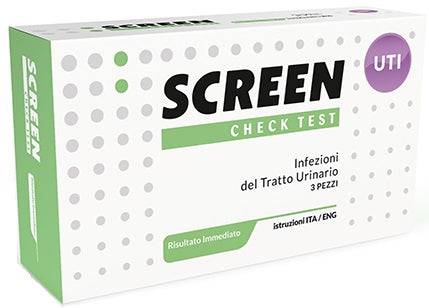
SCREEN
CHECK TEST
Urinary Tract Infections
Description
In vitro diagnostic medical device CE 0123.
Rapid test for the rapid qualitative detection of Leukocytes, Blood, Nitrite and Protein in human urine.
For in vitro self-diagnostic use only.
Precautions
1. For in vitro self-diagnostic use only.
2. Store in a dry place between 2-30°C (36-86°F), avoiding excessively humid areas. If the sealed package is damaged or opened, do not use.
3. Keep out of reach of children.
4. Do not use after the expiration date or if the package is damaged.
5. Strictly follow the indicated times.
6. Use the test only once. Do not disassemble or touch the test strip's test area.
7. For external use only.
8. The used test must be disposed of according to local regulations.
9. If you have difficulty identifying the color (such as color blindness), ask for help reading the test.
How to use
It is recommended to collect a urine sample for testing early in the morning, as it is most concentrated. The urine used for testing should not come into contact with toilet water or any disinfectant or cleaning products.
For women only: The test should not be performed during or within three days of your menstrual cycle. The urine sample should not be contaminated with vaginal fluids, as this may produce misleading results.
Do not make any important medical decisions without first consulting your doctor.
URINE COLLECTION: Collect some of your urine in the plastic container provided or use a clean container free of detergent residue. Be sure to fill the container with urine.
TEST EXECUTION:
1) Open the sealed package and remove the test strip. Do not touch the test fields. Once opened, it is recommended to perform the test immediately.
2) Dip the test strip into the urine sample. CAUTION: Make sure all four test fields are immersed for at least 1-2 seconds.
3) Remove the test strip and remove excess urine by wiping it on the rim of the container or using an absorbent material (e.g., a tissue) to avoid mixing chemicals from nearby areas. Wait 2 minutes (do not read results after 3 minutes).
Reading the results
Color changes at the edges of the test swabs or beyond 3 minutes should be ignored.
NEGATIVE:
- the test field relating to LEUKOCYTES remained tending towards white;
- the BLOOD test field remained yellow-orange;
- the NITRITE test field remained white;
- the PROTEIN test field remained yellowish.
POSITIVE RESULT FOR LEUKOCYTES: if the color of the relevant area has turned purple, it means that leukocytes are present in the urine.
POSITIVE RESULT FOR BLOOD: If the color of the relevant area has turned green (or green dots have appeared at the bottom), it means that there is blood in the urine.
POSITIVE RESULT FOR NITRITE: If the color of the relevant area has turned pink, it means that nitrites are present in the urine.
POSITIVE RESULT FOR PROTEIN: If the color of the relevant area has turned green, it means that there is protein in the urine.
Limits
The urinary tract infection (Urine) test can be affected by substances that cause abnormal urine color, such as medications containing azo dyes, nitrofurantoin, and riboflavin. 1 The color development on the test pad may be masked, or the colored reaction may be interpreted as a false result.
Leukocytes: The result should be read after 2 minutes to allow for full color development. The intensity of the color that develops is proportional to the number of leukocytes present in the urine sample. High protein urine may reduce the intensity of the color reaction. This test does not react with red blood cells or common bacteria in urine.
Blood: A uniform green color indicates the presence of myoglobin, hemoglobin, or hemolyzed red blood cells.1 Scattered or solid green dots indicate intact red blood cells. To improve accuracy, separate color scales are provided for hemoglobin and erythrocytes. Positive test results are often observed in urine from menstruating women. High urine pH has been reported to reduce sensitivity, while modest to high concentrations of ascorbic acid can inhibit color formation.
Microbial peroxidase, associated with urinary tract infections, can cause false positives. The test is slightly more sensitive to free hemoglobin and myoglobin than to intact red blood cells.
Nitrite: The test is specific for nitrite and will not react with any other substance normally excreted in urine. Any uniform pink or red color should be interpreted as a positive result, suggesting the presence of nitrite. The intensity of the color is not proportional to the number of bacteria present in the urine sample. Pink dots or edges should not be considered a positive result. Comparing the test to a white background can help identify low levels of nitrite that might otherwise be missed. The sensitivity of this test is reduced for urine samples containing highly buffered, alkaline urine with a high specific gravity. A negative result in no way excludes the possibility of bacteriuria. Negative results may occur with urinary tract infections caused by organisms that do not contain the reductase that converts nitrate to nitrite; nitrate does not convert to nitrite when urine has not been in the bladder for a sufficient period of time (at least 4 hours); when antibiotic therapy is being administered; or when nitrate is absent from the diet.
Protein: Any shade of green indicates the presence of protein in the urine. This test is highly sensitive to albumin and less sensitive to hemoglobin, globulin, and mucoprotein. A negative result does not rule out the presence of these or other proteins. False positives may occur with alkaline or highly buffered urine. Contamination of urine samples with quaternary ammonium compounds or body soaps containing chlorhexidine may produce false positive results. Urine samples with high specific gravity may yield false negatives.
Conservation
Store in the package at room temperature (2-30°C).
The test is stable until the expiration date printed on the sealed package. The test must remain in the sealed package until use.
DO NOT FREEZE.
Do not use after the expiration date.
Format
Pack containing 3 pieces.
BIBLIOGRAPHY:
1. Henry JB, et al. Clinical Diagnosis and Management by Laboratory Methods, 20th Ed. Philadelphia. Saunders. 371-372, 375, 379, 382, 385, 2001.